01 · 5 agents
Blogify AI
Multi-agent content pipeline with sandboxed secrets and cost telemetry.
Python · FastAPI · Google ADK · Postgres · Grafana · tmpfs
// 01
System Architecture
// 02
ADRs
ADR-001 — Pipeline phase and loop semantics
Purpose
This ADR records the naming and execution-semantics decisions for the blog agent pipeline.
It focuses on:
- why the previous loop naming was ambiguous
- which pipeline shape runs for each persisted blog job phase
- how pause/resume semantics differ from rerun-from-phase semantics
Context
The codebase contains two writer/editor refinement loops that are structurally similar but are not triggered the same way:
- one loop is embedded in the full app pipeline
- one loop is used only by the phase-resume runner
Previously both loops were named refinement_loop.
That created avoidable ambiguity in:
- code reading
- traces and logs
- documentation
- architecture review
The confusion was especially important because the system has multiple job phases:
fresh_generationresume_outlineresearch_phaserevision
Those phases do not all run the same pipeline entrypoint.
Decision
We explicitly distinguish the two loops by trigger context, not by internal structure.
Full app pipeline loop
- helper:
_create_full_pipeline_draft_refinement_loop() - agent name:
full_pipeline_draft_refinement_loop
Meaning:
- this is the writer/editor loop embedded in the full app pipeline after research
Triggered by:
fresh_generation, once the full pipeline reaches research and draftingresume_outline, after outline approval is replayed into the paused full app pipeline
Phase-resume loop
- helper:
_create_phase_resume_draft_refinement_loop() - agent name:
phase_resume_draft_refinement_loop
Meaning:
- this is the writer/editor loop used by the phase runner created through
run_pipeline_from_phase("research_phase")
Triggered by:
research_phasestale-worker recoveryrevisionjobs, which currently re-enter through theresearch_phasephase runner
Phase-To-Runner Mapping
fresh_generation
- executor path:
_execute_fresh_generation - pipeline function:
run_pipeline() - runner shape:
intent_agentoutline_agentoutline_review_agentresearch_agentfull_pipeline_draft_refinement_loop
This is the full app pipeline.
resume_outline
- executor path:
_execute_resume_outline - pipeline function:
resume_pipeline() - runner shape:
- resumes the paused full app pipeline at the outline confirmation boundary
- then continues with:
research_agentfull_pipeline_draft_refinement_loop
This is a true pause/resume path, not a fresh rerun from intent.
research_phase
- executor path:
_execute_research_phase - pipeline function:
run_pipeline_from_phase("research_phase") - runner shape:
research_agentphase_resume_draft_refinement_loop
This is a rerun-from-phase path used after outline approval has already been consumed.
revision
- executor path:
_execute_revision - persisted job phase:
revision - pipeline function:
run_pipeline_from_phase("research_phase") - runner shape:
research_agentphase_resume_draft_refinement_loop
The important distinction is:
- the persisted job phase remains
revision - the execution entrypoint is still the
research_phasephase runner
Review States Versus Pipeline States
AWAITING_OUTLINE_REVIEW
This is a paused app-pipeline state, not an independent pipeline.
Operationally:
- the full pipeline has paused at
review_generated_outline - Postgres persists the approval metadata needed for resume
- no worker should continue execution until a user review endpoint submits approval/edit feedback
AWAITING_FINAL_REVIEW
This is an application review state around persisted output, not an ADK pause boundary.
Operationally:
- research and drafting have already finished
- output has been persisted to the active version/session
- the user may:
- approve
- request revision
- reject
Consequences
Positive
- code now exposes which refinement loop belongs to which execution path
- traces and runtime inspection become less ambiguous
- docs can describe job phases without collapsing multiple paths into one "writer/editor loop"
Tradeoff
- there are still two loops with identical internal structure
- the distinction is semantic and trigger-based, not behavioral
That is intentional. The main issue was reader ambiguity, not a need to change execution behavior.
ADR-002 — Redis queue recovery and queue session reconciliation
Purpose
This ADR documents the recovery changes added to close two queue-consistency gaps in the blog worker system:
- Redis processing entries expiring without being re-enqueued
QUEUEDsessions in Postgres becoming orphaned when no Redis job exists
This document focuses on:
- which failure windows were left open by the previous design
- why lease-based recovery alone was not enough
- why the chosen fix uses layered recovery instead of a full outbox redesign
- what invariants now define queue ownership and requeue behavior
Context
Before this change, recovery was split unevenly across Redis and Postgres:
- Redis queue transport used a visibility-timeout model through
blogify:processing - Postgres tracked session lifecycle and worker leases
- stale DB leases were recovered by the reaper
- stale Redis processing entries were only cleaned up, not re-enqueued
That left two concrete gaps.
Gap 1: dequeue succeeded, lease acquisition never happened
The worker dequeues a Redis job before it creates a DB lease.
If the worker dies in that window:
- the job has already left
blogify:tasks - there is no
session_leasesrow for stale-lease recovery to find - the session still looks
QUEUEDin Postgres - the expired Redis processing entry was previously deleted rather than retried
This was a true job-loss path.
Gap 2: Postgres says QUEUED, Redis has no job
The API and review flows mutate Postgres state and enqueue Redis work separately.
If Redis enqueue fails, is lost, or is manually cleaned up later, Postgres can still contain a valid runnable session while Redis contains no corresponding queued or processing payload.
That leaves:
- no active lease
- no worker execution
- no terminal failure
- no automatic recovery
Decision
We chose a layered recovery model instead of introducing a transactional outbox in this change.
1. Redis processing expiry must requeue orphaned transport claims
Expired Redis processing entries should no longer be deleted unconditionally.
Instead:
- if the entry represents a session that is still
QUEUED - and there is no active DB lease
- and the session was not already requeued by stale-lease recovery
Then the Redis payload is moved back to blogify:tasks.
This specifically recovers the "dequeued but never leased" window.
2. Lease-based recovery remains the source of truth for in-flight DB-owned work
If DB state shows that a worker lease existed or that reaper-driven recovery has already taken ownership, Redis transport cleanup must not independently create another retry.
That means stale Redis processing entries are only re-enqueued for sessions that still look queue-owned in Postgres.
For sessions already handled by lease recovery:
- the Redis processing entry is treated as stale transport residue
- the entry is removed but not requeued again
3. Add DB-to-Redis reconciliation for stranded QUEUED sessions
We added a periodic reconciliation pass that scans for sessions where:
blog_sessions.status = QUEUED- no active lease exists
- the session is older than a short grace period
- no corresponding Redis payload exists in either the ready queue or processing set
Those sessions are re-enqueued from persisted DB state.
This makes Postgres the recovery source of truth when Redis has lost a runnable job entirely.
4. Do not introduce a transactional outbox in this change
A transactional outbox would address producer-side enqueue durability, but it does not directly solve the consumer-side "dequeued before lease" failure window.
The chosen change was intentionally narrower:
- preserve the existing Redis + lease architecture
- close the concrete recovery gaps already observed
- avoid a larger producer/dispatcher redesign until it is justified by additional failure evidence
Recovery Model After This Change
The system now has three overlapping recovery layers.
Redis transport reclaim
Handles:
- jobs removed from the ready queue
- never successfully turned into DB-leased work
Mechanism:
- reaper inspects expired Redis processing entries
- eligible entries are pushed back into the Redis ready queue
Lease-based stale-worker recovery
Handles:
- jobs that did acquire a DB lease
- workers that died mid-execution
Mechanism:
- reaper expires stale leases
- reaper moves session state from
PROCESSINGback toQUEUED - reaper constructs a new job from persisted DB state
DB reconciliation
Handles:
- sessions that remain
QUEUED - no active lease exists
- Redis no longer has any corresponding queued or in-flight payload
Mechanism:
- reaper rebuilds missing Redis jobs from persisted session + active-version state
Implemented Changes
Queue behavior
- Added queue helpers to inspect tracked Redis session IDs
- Added an explicit helper to move expired processing entries back to the ready queue
Reaper behavior
- Reaper now distinguishes between:
- stale transport residue to clean up
- orphaned transport claims to requeue
- Reaper now runs a queued-session reconciliation pass after stale-lease and stale-processing handling
Session repository behavior
- Added a query for aged
QUEUEDsessions with no active lease
Why This Is Correct Enough For Now
This change does not claim cross-system atomicity between Redis and Postgres.
What it does provide is a more complete at-least-once recovery story:
- if Redis lost the claim before a lease existed, Redis reclaim restores it
- if a worker died after a lease existed, stale-lease recovery restores it
- if Postgres says work should exist but Redis forgot it entirely, reconciliation restores it
That is a materially stronger guarantee than the previous design, while keeping the existing architecture intact.
Consequences
Positive
- closes the known job-loss window before DB lease creation
- prevents silent stranding of
QUEUEDsessions with no Redis presence - keeps recovery decisions anchored in persisted DB state
- avoids immediate adoption of a larger outbox/dispatcher design
Tradeoffs
- recovery logic is now more layered and more stateful
- reaper owns more policy than before
- recovery remains at-least-once, not exactly-once
- producer-side enqueue durability is still not equivalent to a full outbox pattern
Follow-up Considerations
If future incidents show producer-side enqueue loss remains common, the next design step should be a transactional outbox for:
- initial generation enqueue
- outline resume enqueue
- revision enqueue
That would complement, not replace, the consumer-side recovery introduced here.
// 03
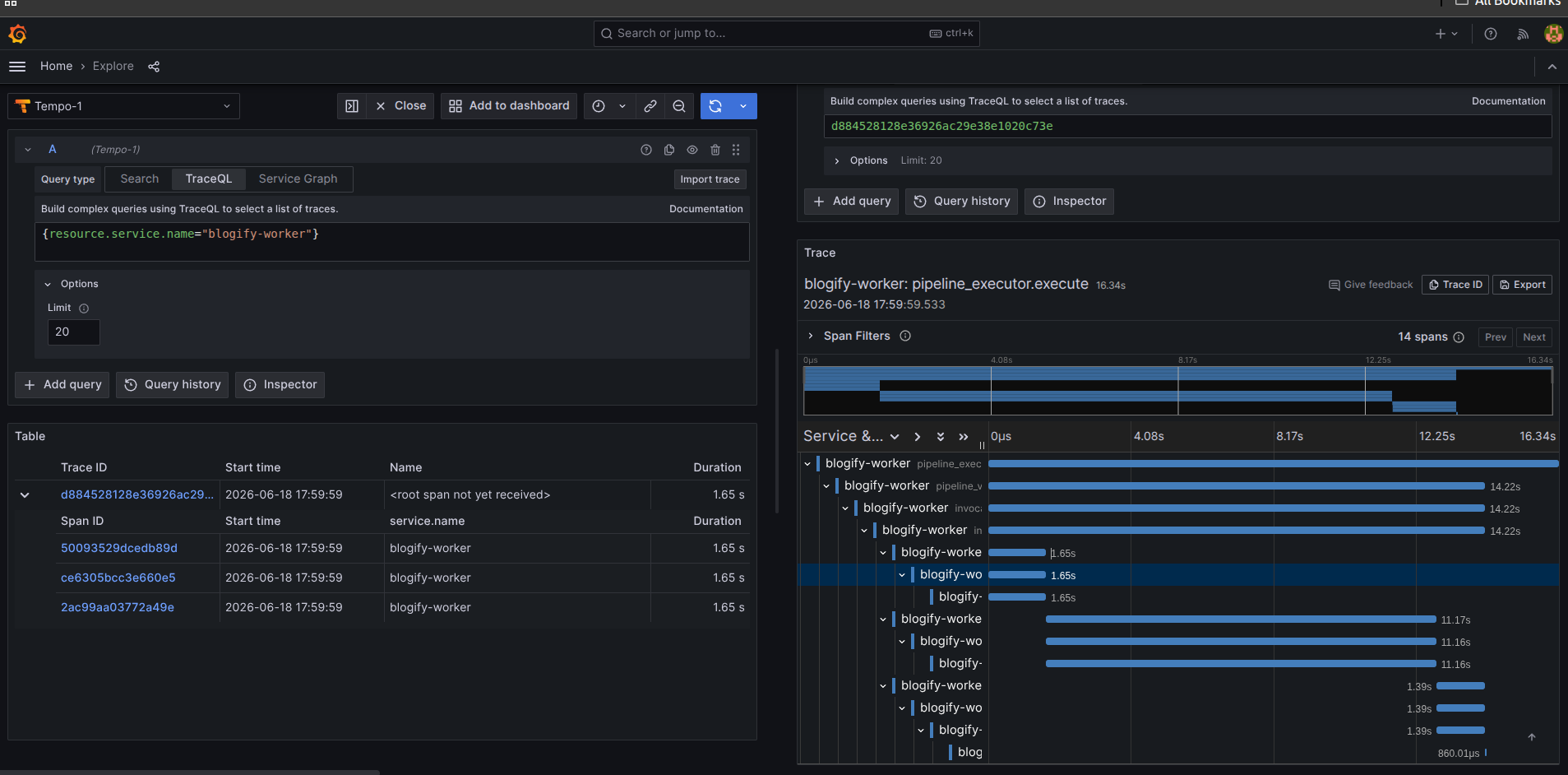
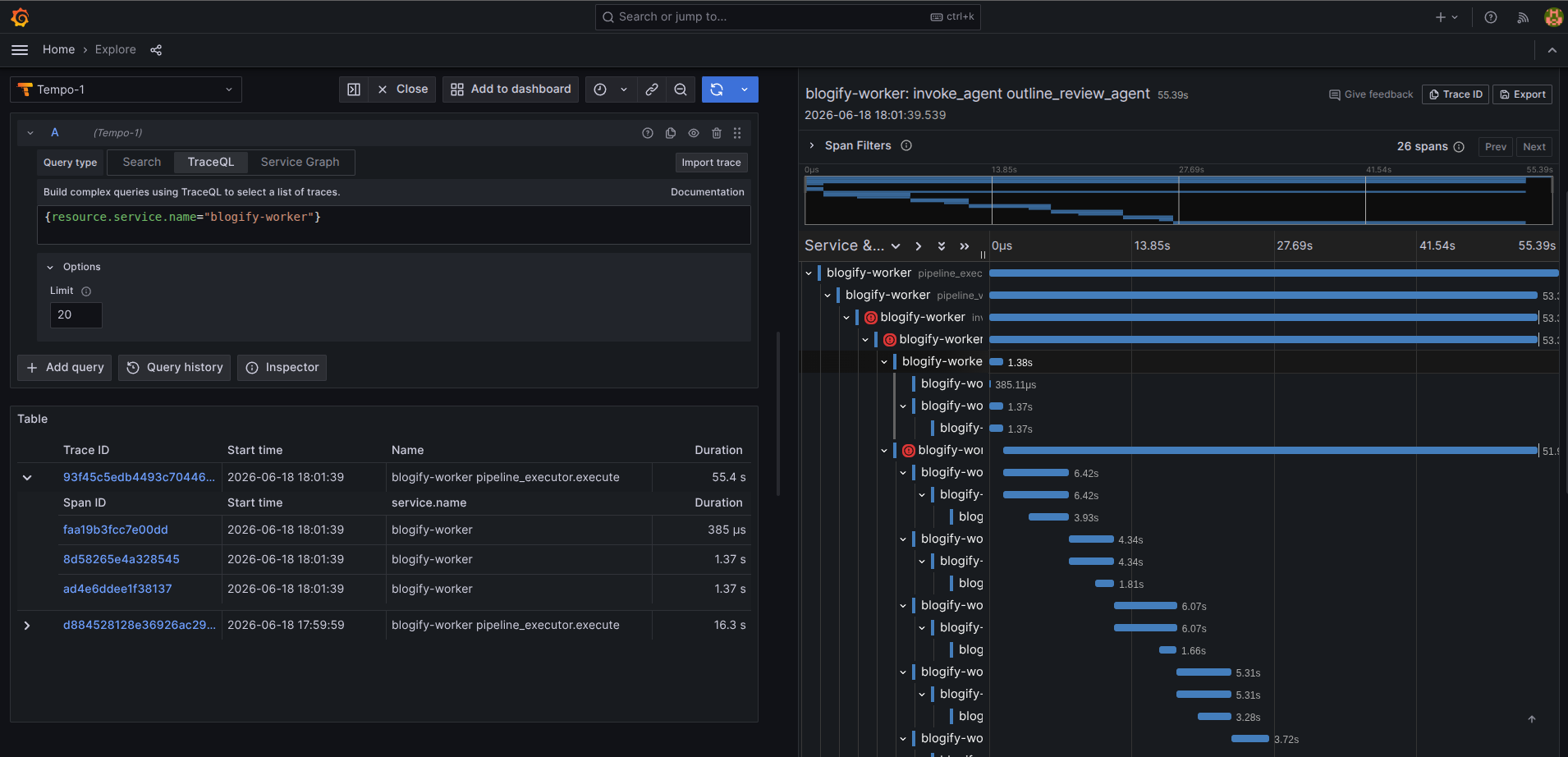
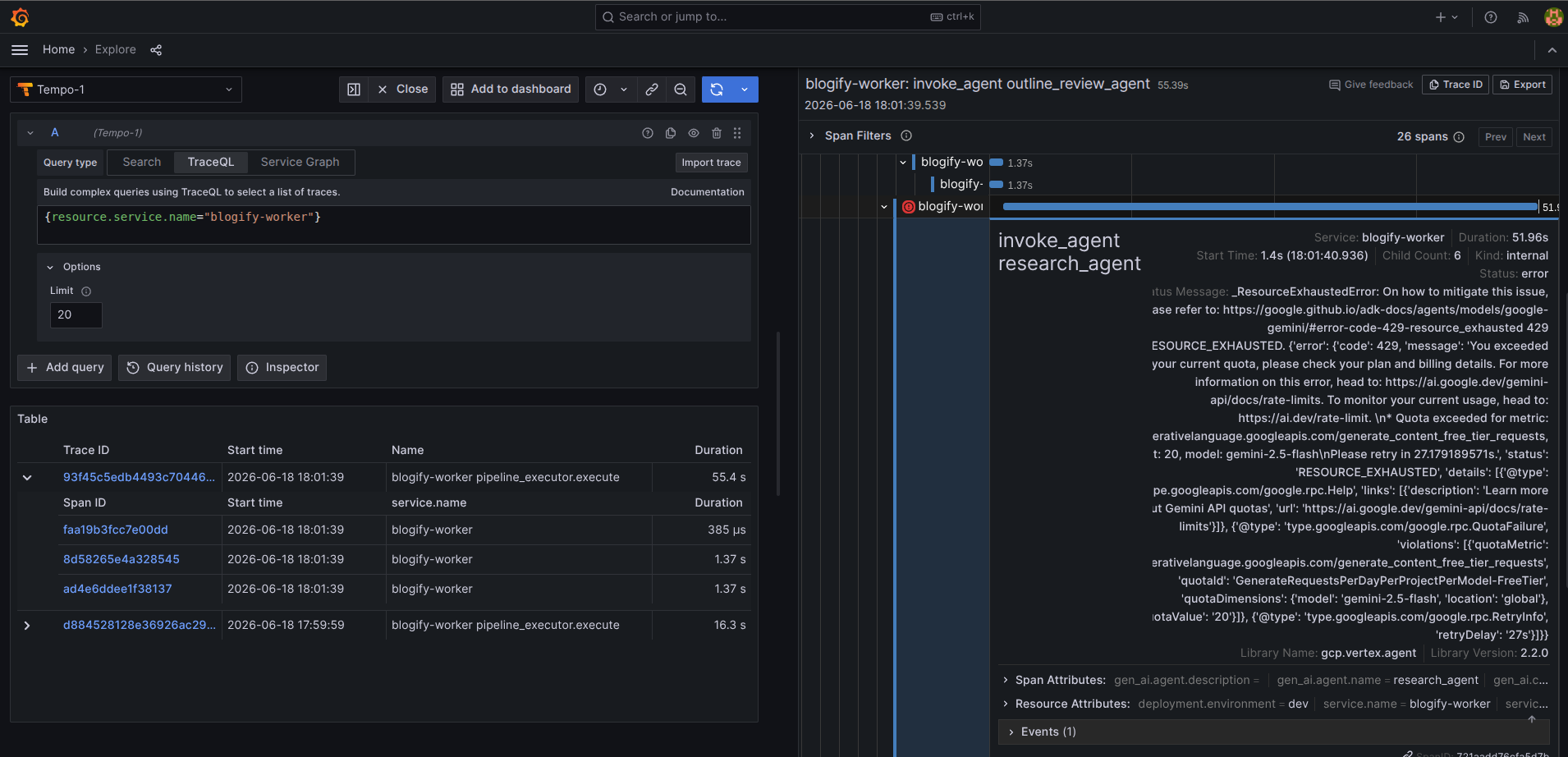
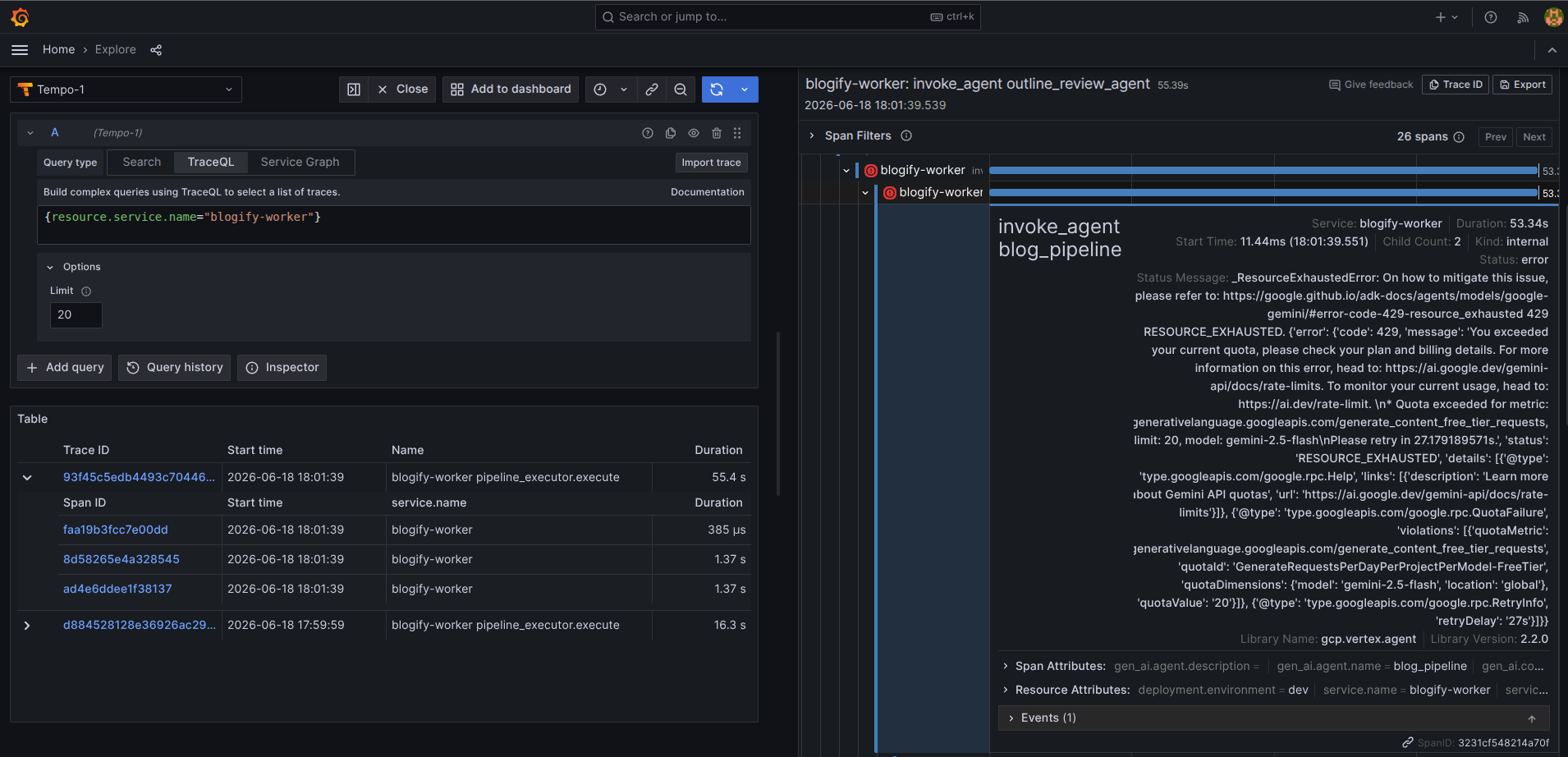
Distributed Tracing with Tempo
Every agent invocation, tool call, and pipeline phase emits OpenTelemetry spans shipped to Grafana Tempo. Traces are queried in Grafana Explore with TraceQL (`{resource.service.name="blogify-worker"}`) to drill from the top-level pipeline executor down into individual agent errors, retries, and provider rate-limit failures.